
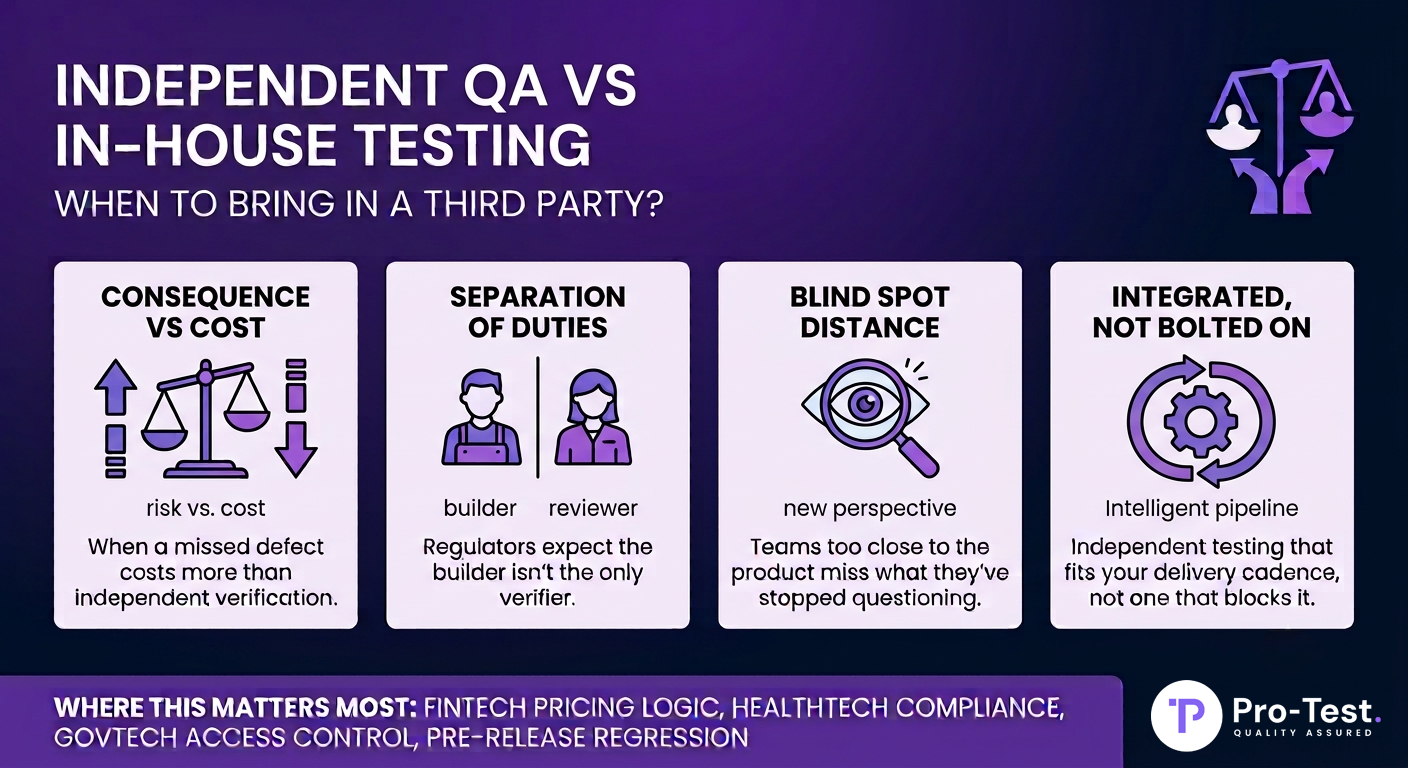
The short answer: bring in independent QA when the cost of a missed defect is higher than the cost of a second opinion — which, in regulated or customer-critical software, is almost always. In-house testing isn’t wrong. It’s just structurally limited in one specific way: the team that builds the software has every incentive, mostly unconscious, to believe it works.
This isn’t a knock on in-house engineers or QA teams. It’s a description of how confirmation bias operates in any team testing its own output. The question isn’t “is our in-house QA good enough” — it’s “can the people who wrote the code, and the people who report to the same manager as the people who wrote the code, catch the thing they didn’t think to test for.”
What’s the actual difference between in-house and independent QA?
In-house QA is testing performed by people embedded in the same team, reporting line, and delivery pressure as the developers who built the feature. Independent QA is testing performed by people with no stake in the feature shipping on time, no relationship with the developer whose code is under review, and — critically — no shared blind spots with the team that built it.
The distinction isn’t about skill. A strong in-house QA engineer can out-test a mediocre external one. It’s about structural independence: whether the person deciding “this is ready” has any organisational incentive to say yes.
When does in-house testing genuinely work well?
In-house QA is the right call, not just the cheaper one, in a specific set of situations:
- Low-consequence software — internal tools, prototypes, features behind an experimental flag where a bug costs an afternoon of cleanup, not a regulatory finding
- Fast-moving product teams where speed matters more than exhaustive edge-case coverage, and the team has a strong quality culture already
- Domains the team deeply understands, where tribal knowledge about how the system breaks is itself a testing asset
- Early-stage products validating whether something should exist at all, before the cost of getting it wrong has scaled
None of this changes once you’re in a regulated industry, handling money, health data, or infrastructure other systems depend on. At that point the calculus flips.
When does independent testing become necessary, not optional?
Three signals reliably indicate it’s time:
The consequence of a missed defect exceeds the cost of independent verification. A pricing bug in a fintech platform, a data-handling error in a health app, or an access-control gap in a GovTech system doesn’t cost an afternoon — it costs a regulatory finding, a customer harm, or a breach disclosure. Once the downside is that asymmetric, “we’re pretty confident” isn’t a sufficient testing standard.
Regulators or auditors expect separation of duties. This is now explicit for many fintechs post-Consumer Duty, and standard practice in HealthTech (IEC 62304), and increasingly expected in GovTech procurement. If the person who built the pricing logic is also the only person who verified it, that’s a governance gap an external review will flag — independent of whether the code actually works.
The team is too close to the product to see what’s missing. This is the least discussed but often the most costly. A team that’s been building a feature for three months has internalised a set of assumptions about how users behave, what edge cases matter, and what “normal” input looks like. An independent tester comes in without those assumptions — and without them, tests scenarios the internal team never thought to write down, because they didn’t know they were assuming anything.
Does independent testing mean replacing in-house QA?
No — and treating it as an either/or is usually a mistake. The strongest setups use in-house QA for fast-cycle functional testing embedded in the sprint, and independent testing for the higher-stakes layer: pricing logic, compliance-relevant flows, security-sensitive changes, and pre-release regression on anything customer-facing at scale.
Independent testing is also not the same as outsourced testing in the sense of “cheaper testers in a different time zone.” The value isn’t lower cost — it’s structural distance from the build decisions. A good independent QA partner should be asking questions the internal team stopped asking three sprints ago.
What should you actually look for in an independent QA partner?
If you’ve concluded independent testing makes sense for at least part of your product, the partner selection question comes down to a few things:
- Do they understand your regulatory context, or are they applying generic QA process to a fintech, healthtech, or govtech product without understanding what a regulator will actually ask for?
- Do they produce evidence, not just pass/fail reports — traceability from requirement to test case, retained and retrievable on demand?
- Are they AI-enabled without being AI-only? Automated testing accelerates coverage, but in regulated software, a human still needs to own judgment calls about what “correct” means for an edge case a model wasn’t trained to recognise.
- Do they integrate into your delivery cadence, or do they become a bottleneck that turns every release into a two-week wait?
This is precisely the gap AppAtlas and Pro-Verify are built to close — independent verification that maps directly to what a regulator or auditor will ask for, integrated into your existing delivery pipeline rather than bolted on before release. Our position is straightforward: AI-only QA is a liability in regulated industries. You need AI-enabled, human-led.
If you’re not sure whether your current setup has this kind of independence built in, that’s usually the first thing worth checking. Get in touch for a candid conversation about where the gaps are — no pitch, just a look at the setup.